
Introduction
This article explains lumbar foramen anatomy and why it matters in endoscopic spine surgery.
The lumbar foramen is an important opening located on both sides of each lumbar vertebra. In endoscopic spine surgery, this opening functions as a carefully planned access corridor that allows surgeons to reach the spinal canal and the posterior aspect of the intervertebral disc during transforaminal procedures.
A precise understanding of lumbar foraminal anatomy is fundamental for procedural safety and effectiveness.
Why endoscope size matters: The endoscope must pass through the natural opening of the foramen. A smaller-diameter endoscope can be introduced with no bone trimming, while larger systems often require bone removal simply to make room for the equipment.
More on this topic: Lumbar Foramen
Anatomical Variability of the Lumbar Foramen
For surgery to be safe and effective, it is essential to understand both the normal anatomical variations of this space and how it changes with age or degeneration. Research studies have measured the size and shape of the lumbar foramen; however, these measurements vary among individuals.
Factors such as aging, disc collapse, and arthritis of the facet joints can significantly alter the available working corridor. Because of this natural variability, no two patients are exactly alike.
While anatomical studies provide helpful reference values, individualized imaging assessment remains crucial.
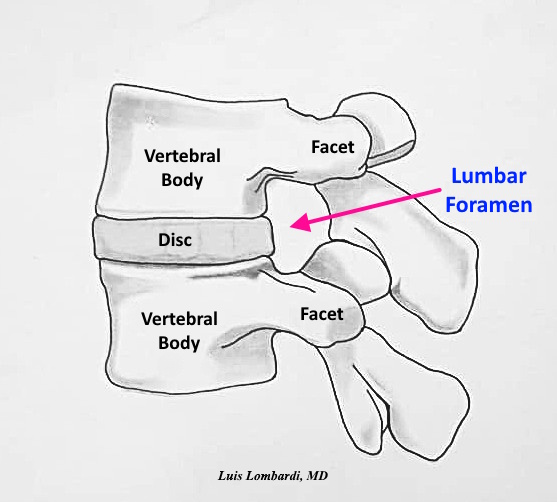
The anatomical corridor shown above represents the entry zone used during transforaminal procedures
Surgical Planning and Instrument Selection
Decisions regarding instrument diameter, surgical trajectory, and the need for bone removal must be tailored to each patient. The relationship between foraminal dimensions and endoscope diameter directly influences whether facet resection becomes necessary.
In simple terms, the goal is to fit the necessary equipment through the safe pathway. When the instruments are smaller, surgeons can preserve the surrounding bony anatomy and focus on the pathology.
In modern endoscopic spine surgery, detailed anatomical evaluation is the foundation of safe and tissue-preserving intervention.
Relationship to Kambin’s Triangle
The safe working zone within the lumbar foramen corresponds anatomically to what is classically described as Kambin’s triangle. This triangular corridor defines the transforaminal access pathway and varies according to spinal level and degenerative status.
Understanding the boundaries of Kambin’s triangle is essential when planning surgical access within the lumbar foramen.
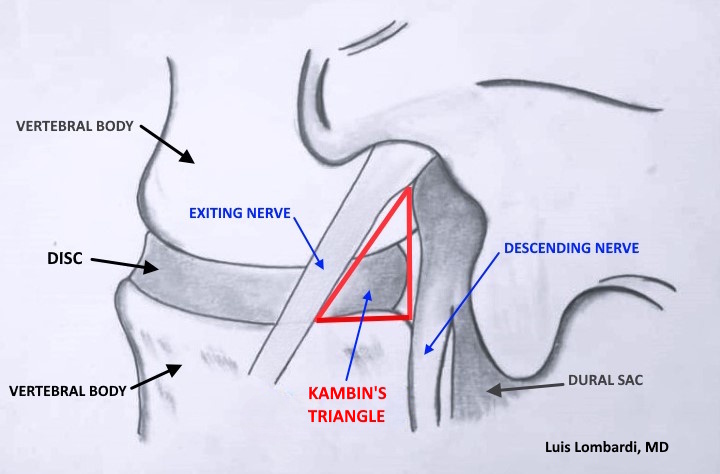
The geometric boundaries illustrated define the transforaminal working corridor used in endoscopic spine surgery. Instrument feasibility within this space depends on both anatomical dimensions and endoscope diameter.
For patients, this translates into a straightforward idea: the more the instrument fills the available space, the more likely it is that the surgeon must create extra room. Using a smaller endoscope facilitates the preservation of normal surrounding tissues.
Impact of Degenerative Foraminal Stenosis
Degenerative processes—including loss of disc height, facet joint arthrosis, and foraminal stenosis—can substantially diminish the available surgical corridor. These changes also alter the dimensions of Kambin’s triangle, narrowing the traditional triangular safe zone.
In advanced cases of degenerative foraminal stenosis, the available working space may be significantly reduced. As space becomes more restricted, smaller endoscopic systems may facilitate safer access while minimizing or avoiding bone removal.
Imaging Evaluation and Preoperative Assessment
Preoperative MRI and CT imaging provide a detailed assessment of the lumbar foramen in each patient. Because anatomical dimensions differ between individuals, imaging guides:
- Instrument size selection
- Surgical trajectory planning
- Determination of whether bone removal is required
When appropriate, the use of smaller endoscopic systems can reduce the need for unnecessary bone resection.
Frequently Asked Questions About Lumbar Foramen
What is the safe working zone in endoscopic transforaminal spine surgery?
The safe working zone is the portion of the lumbar foramen that allows surgical instruments to access the spinal canal and intervertebral disc while minimizing risk to nearby neural structures. This corridor corresponds anatomically to Kambin’s triangle, and its dimensions vary depending on spinal level and degeneration.
How does degeneration affect the lumbar foramen?
Degenerative changes such as disc height loss, facet hypertrophy, and foraminal narrowing reduce the available working space. In advanced degeneration, the corridor may become significantly restricted, influencing both surgical trajectory and instrument selection.
Why is preoperative imaging important before transforaminal endoscopic surgery?
Preoperative imaging allows precise evaluation of lumbar foraminal dimensions and neural relationships. It helps determine appropriate endoscope diameter, access angle, and whether facet resection is required.
How do surgeons decide whether facet removal is necessary?
Facet resection is considered when the natural foraminal corridor cannot safely accommodate the chosen instruments. Larger endoscopic systems may require facet removal, whereas smaller endoscopes often allow preservation of native anatomy.
Conclusion
The lumbar foramen represents the central anatomical corridor in endoscopic transforaminal spine surgery. Its dimensions are dynamic and influenced by individual variability and degenerative changes. Safe surgical planning depends on detailed imaging evaluation, appropriate instrument selection, and a clear understanding of its relationship to Kambin’s triangle.
Anatomical precision remains the cornerstone of endoscopic spine surgery.
More on Lumbar Foramen Anatomy:
If you’d like to go deeper into lumbar foramen anatomy and how it affects endoscopic planning, these articles expand on the key concepts:
Lumbar foramen (cluster index)
Degenerative foraminal stenosis: what it means and how surgeons plan endoscopic access
Kambin’s triangle explained: the safe zone used in transforaminal endoscopic surgery
Endoscope Diameter and Foraminal Access in Endoscopic Spine Surgery